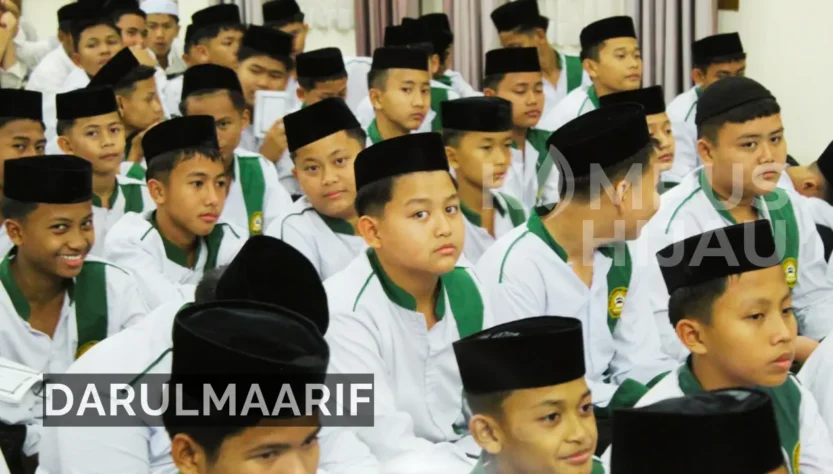
darulmaarif.net – Indramayu, 06 April 2026 | 10.00 WIB
In the midst of the rapid flow of digitalization, today’s parents face not simple anxieties: Children are increasingly difficult to direct, easily exposed to negative content, and are slowly experiencing worrying changes in attitudes. This phenomenon is not just a perception, but has been confirmed by various national data.
The 2024 National Survey of Life Experiences of Children and Adolescents (SNPHAR) shows that around 50.78% of children aged 13–17 years in Indonesia have experienced at least one form of violence in their lives.. In fact, another report states that more than 8,000 cases of youth violence occur in one year.
On the other hand, very high digital penetration exacerbates this condition. More than 95% of Indonesian teenagers have active social media accounts, with average usage reaching almost 3 hours per day. This massive exposure not only influences thought patterns, but also shapes behavior, ethics, and even ways of interacting.
This is the real face of the moral crisis in the digital era: when technology develops rapidly, but moral values actually experience degradation. The problem is not merely the progress of information technology, but rather the absence of values that guide the use of technology itself.
When Information is Abundant, but the Direction of Life is Blurred
Teenagers today live in a flood of information. They can figure out anything in a matter of seconds, but don’t always know the right one to follow. They are used to seeing, imitating and reacting quickly, but are not given enough space to reflect.
This is where the paradox arises: the more one knows, the less one understands in depth. Ultimately, morals are not formed, because morals are not just knowledge—they are the result of habituation, example, and a consistent environment.
Without all that, teenagers will grow up as individuals who are cognitively intelligent, but morally fragile.
Social Media and Shifting Values
Social media has become a “second teacher” for many children. What they see every day slowly shapes their way of thinking, their way of speaking, and even their way of looking at life. Unfortunately, not everything that goes viral is valuable.
Instant culture, self-image, and the search for validation often replace the values of honesty, patience, and simplicity. Teenagers are encouraged to appear, not to be. They learn to look good, not to actually be good.
In situations like this, parents often lose out quickly. Advice delivered at home is no match for the endless stream of content.
Islamic boarding school as a space for restoring values
In the midst of these conditions, Islamic boarding schools exist not just as educational institutions, but as spaces for the restoration of values. It offers something that is increasingly rare in this day and age: a maintained environment, a regular rhythm of life, and closeness to spiritual values.
Islamic boarding schools not only teach knowledge, but form life habits. From waking up in the morning until going back to sleep, children live in a system that trains discipline, responsibility and self-awareness. They not only learn about kindness, but are accustomed to practicing it every day.
This is what you often don’t get outside: consistency.
Environment that Shapes Character
One of the main strengths of Islamic boarding schools is their environment. Children not only learn from teachers, but also from friends, the atmosphere and the routines they share together.
A good environment has a huge influence. It works silently, but takes shape slowly. Children who are used to living in a disciplined atmosphere will learn to be disciplined. Children who are used to seeing examples will learn to emulate.
In this context, Islamic boarding schools are not only places to learn, but places to grow.
From Habit to Character
Character changes do not happen instantly. It is born from small habits that are carried out continuously. Pesantren understand this principle very well.
Routines of worship, study and daily life are arranged in such a way that children get used to living with values. From that habit, character is born. From character, a strong personality is formed.
What initially felt like a rule, slowly turned into a necessity.
Between the Challenges of the Times and Parental Choices
The moral crisis of teenagers in the digital era is not something that can be completely avoided, but can be anticipated. It is not enough for parents to just supervise, but needs to take strategic steps in determining their child’s educational environment.
Islamic boarding schools are one relevant answer. Not because it is perfect, but because it offers a balance between knowledge, morals, and spiritual life—something that is increasingly rare in modern education systems.
Choosing an Islamic boarding school does not mean keeping children away from the world, but rather preparing them to face the world with stronger provisions.
It’s time to act, not just worry
Parents’ concerns are normal. However, worry without action will only become regret later. When signs of change are visible, it is a call to action.
Educating children is not just about meeting today’s needs, but ensuring their future remains on the right path.
Your Child’s Education Consultation
If you face:
A child who is difficult to advise
Gadget addiction
Alarming change in attitude
We are ready to help you find the best solution.
✨ Free consultation for guardians of students
👉 Discuss your child’s problems directly
👉 Get proper educational instructions
👉 No fees, no commitment
Contact us via WhatsApp now:
📲 https://api.whatsapp.com/send/?phone=6289657537666&text&type=phone_number&app_absent=0&wame_ctl=1
Because a child’s future is not only determined by developments over time, but also by current parental decisions.
Hope it is useful. Wallohu a’lam.
PakarPBN
A Private Blog Network (PBN) is a collection of websites that are controlled by a single individual or organization and used primarily to build backlinks to a “money site” in order to influence its ranking in search engines such as Google. The core idea behind a PBN is based on the importance of backlinks in Google’s ranking algorithm. Since Google views backlinks as signals of authority and trust, some website owners attempt to artificially create these signals through a controlled network of sites.
In a typical PBN setup, the owner acquires expired or aged domains that already have existing authority, backlinks, and history. These domains are rebuilt with new content and hosted separately, often using different IP addresses, hosting providers, themes, and ownership details to make them appear unrelated. Within the content published on these sites, links are strategically placed that point to the main website the owner wants to rank higher. By doing this, the owner attempts to pass link equity (also known as “link juice”) from the PBN sites to the target website.
The purpose of a PBN is to give the impression that the target website is naturally earning links from multiple independent sources. If done effectively, this can temporarily improve keyword rankings, increase organic visibility, and drive more traffic from search results.